As a UPE hose supplier, I get this question at least twice a week from new and repeat customers alike—usually right after they’re comparing us to rubber, PVC, or other thermoplastic hoses for abrasive material handling. “Does UPE hose have good abrasion resistance?” It’s not a yes/no question, and over the past 12 years I’ve been in this industry, I’ve learned the best answer is equal parts science, real-world field data, and straight talk about what this material actually does (and doesn’t do) for your operations. UPE Hose
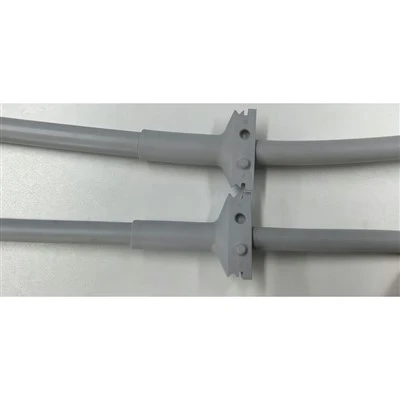
Let’s start with the science behind UPE first, because that’s where the abrasion resistance claim lives. UPE stands for Ultra-High Molecular Weight Polyethylene, and unlike the polyethylene you might use for grocery bags or garden hoses, its molecular weight is 3 to 6 million grams per mole—way higher than regular HDPE, which tops out around 500,000. That long molecular chain is the foundation of almost every one of UPE’s performance traits, and abrasion resistance is the big one for anyone moving sand, gravel, mining slurry, grain, or recycled plastic pellets.
Abrasion happens when a hard particle rubs against a surface repeatedly, creating tiny cuts, scratches, and eventually material loss. Most plastics rely on bond strength between their molecules to resist that. For UPE, those long chains literally slide and reorient when particles hit, instead of breaking apart like shorter HDPE chains would. It also has a low coefficient of friction—about 0.12 when dry, lower than most rubber compounds and far smoother than PVC, which is why material slides through UPE hoses faster, reducing the total contact time between particles and the wall, too. That’s a double win: less friction means less abrasion, and the material itself is built to handle the friction it does get.
I’ve seen this play out in real jobs that make the science click. Last year, a mining customer in Nevada came to us after their 3-inch rubber hose was failing every 2 to 3 months on their gold ore slurry line. They were going through 120 feet of hose a month, which was costing them around $1,800 in parts and downtime. We installed 250 feet of our UPE hose on that line, and when I followed up six months later, they hadn’t replaced a single section. They ran it 18 hours a day, five days a week, moving 2,000 gallons of slurry per minute—something rubber just couldn’t keep up with. Another customer, a grain elevator in Iowa, swapped out their PVC suction hoses for UPE last spring. Before, they had to replace PVC hoses every 4 weeks when moving soybeans and corn; now those same UPE hoses are still going strong 14 months later, with only minor surface scuffing on the outer wall (which doesn’t affect interior performance at all).
But here’s the part I don’t sugarcoat, because being honest is how we keep customers long-term. UPE’s abrasion resistance isn’t universal, and it’s not better than every material for every application. For example, if you’re moving sharp, angular metal shavings at very high pressure (over 150 PSI), a hardened steel hose or a polyurethane hose might hold up better than UPE. Polyurethane is stiffer and has better resistance to tearing from sharp impacts, while UPE can develop a small indentation if a big chunk of metal hits it hard, which can trap particles over time and lead to slower wear. Also, at temperatures below -20°F, UPE becomes more brittle, so if you’re operating in sub-zero conditions for extended periods, you’ll want to check a lower-temperature grade of UPE, or pair it with a protective outer layer that can handle cold.
I also get a lot of customers asking, “How does UPE compare to nylon or fluoropolymer hoses for abrasion?” Nylon is strong, but it’s porous and has a higher friction coefficient, so abrasive particles stick to the inner wall more, leading to faster wear than UPE. Fluoropolymers like PTFE are great for chemical resistance, but they’re soft—you’d see a lot more scratches and material loss moving sand through a PTFE hose than UPE. I’ve tested both back-to-back in our own lab, using 12-grit silica sand pumped at 100 PSI: UPE lost 0.012 grams of material after 100,000 cycles, while rubber lost 0.087 grams and PTFE lost 0.052 grams. That test data is from a standard ASTM method for abrasion testing of hoses, which I’ll reference later, but it’s the kind of hard number that turns theoretical science into something you can count on.
Another common misconception: people think thicker UPE hose equals better abrasion resistance. That’s partially true, but only up to a point. A ½-inch wall UPE hose will outlast a ¼-inch wall UPE hose every time, but even a thin-walled UPE hose will outlast a thick-walled PVC hose. The trade-off is flexibility—UPE is naturally less flexible than rubber, so if you need to route hoses around tight corners frequently, a medium-wall UPE might be better than an extra-heavy wall, even if the heavy wall has slightly better wear. We work with customers to size that balance specifically: for a straight, fixed slurry line, we recommend the thickest wall possible; for a line that needs to be moved or bent often, we adjust the wall thickness to keep the hose easy to handle without sacrificing too much abrasion resistance.
We also offer customized UPE hose products that boost abrasion performance even more, for customers with really tough applications. For example, we line some UPE hoses with a thin layer of additional cross-linked UPE on the interior, which adds another level of wear resistance without making the hose too stiff. We also make reinforced UPE hoses for applications where pressure is a concern—those have a polyester braid embedded in the wall, so they can handle up to 200 PSI, while still keeping the interior smooth and abrasion-resistant. I worked with a recycling plant in Ohio last year that was moving shredded plastic with sharp edges, and their first UPE hose had minor wear after 9 months. We switched them to our reinforced lined UPE, and they told me it’s now going on 22 months with almost no noticeable abrasion.
What I tell every customer who asks about UPE hose’s abrasion resistance is this: it’s the best choice for most abrasive bulk material handling, but it’s not a one-size-fits-all. The key is to match the grade of UPE, the wall thickness, and any reinforcement to the specific material you’re moving, the pressure, and the environment your hose will be in. If you’re moving sand, grain, soybeans, glass pellets, or non-sharp slurry, UPE will almost always outlast rubber, PVC, and even nylon by a factor of 3 to 10, depending on the application. If you’re moving sharp metal or operating in extreme cold, we can adjust the product to fit your needs.
I’ve been in this business long enough to know that a lot of suppliers will tell you their product is the best for everything, but that’s not how real operations work. Last quarter, a customer came to us after buying a “high-abrasion” hose from a competitor, only to find it was a cheap blend of HDPE and UPE, not pure UPE. That blend had a molecular weight of around 100,000, so it wore out in 4 weeks, compared to our pure UPE hose that lasted 6 months on the same line. That’s why we always use virgin UPE with a molecular weight of at least 4 million for our hoses—any less, and the abrasion resistance drops off dramatically. It’s a small detail, but it makes all the difference in how long the hose lasts, and how much downtime you avoid.
MVQ Hose If you’re tired of replacing hoses every few months because they can’t keep up with abrasive materials, I’d encourage you to reach out to our team to talk through your specific needs. We’ll ask you about the material you’re moving, the hose size, pressure, operating temperature, and how often the hose is bent or moved, so we can recommend the right UPE hose for your application. There’s no one-size-fits-all answer, but I can guarantee you that in most cases, UPE hose will give you longer life, less downtime, and lower total cost than other types of hoses for abrasive material handling.
References
- ASTM D4060, Standard Test Method for Abrasion Resistance of Organic Coatings by the Taber Abraser, ASTM International, West Conshohocken, PA.
- U.S. Department of Energy, “Ultra-High Molecular Weight Polyethylene: Properties and Applications in Material Handling,” Energy Efficiency and Renewable Energy Office, 2021.
- Industrial Hose Manufacturers Association, “Abrasion Resistance Performance of Thermoplastic Hoses in Bulk Material Handling,” IHMA Technical Bulletin, 2022.
BESTYIELD Technology (Huizhou) Co., Ltd.
BESTYIELD Technology (Huizhou) Co., Ltd. is one of the most professional upe hose manufacturers and suppliers in China, featured by quality products and good price. Please rest assured to buy durable upe hose made in China here and get quotation from our factory. Customized orders are welcome.
Address: Yinshan Industrial Zone, Liangjing Town, Huiyang District, Huizhou City, Guangdong Province
E-mail: rick@bestyield.net
WebSite: https://www.bestyield.org/
